
In recent years, an idea has taken hold in youth sports: that young athletes need to be doing sport-specific training in the weight room if they want to get better at their sport. By definition, this means that in the gym, they should only be doing things that directly translate to their sport, and their sport alone. It’s one of the many myths that’s parents have been sold over the years.
Unfortunately, this is a lie. “Sport-specific training” is nothing more than a buzz phrase, used by trainers as a marketing ploy, and it’s one every parent of a youth athlete should learn to recognize.
What Does Sport-Specific Training Actually Mean?
Take golf, for example. If you want something truly sport-specific for golf, you need a golf club in your hand. The same logic applies to any other sport: you should be practicing the sport itself. If you’re a hockey player, that means a stick in your hand. If you play soccer, sport-specific means drilling with a ball. For basketball, it means being on the court. The weight room is not the place for sport-specific training — especially for youth athletes.
The Real Goal of Youth Strength and Conditioning: General Physical Preparedness, NOT Sport-Specific
The whole point of the weight room, and of a strength and conditioning program, is to build an athlete the biggest possible base of athleticism. The goal is to increase strength, power, speed, agility, flexibility, mobility, and durability, so that an athlete can take those qualities and apply them to the actions of their sport.
All of the qualities listed above fall under the category of general physical preparedness (GPP). This type of training is about building a frame, and an engine, for the athlete to run on.
Imagine building your dream car and spending all your time on the bells and whistles — air-conditioned seats, a top-of-the-line entertainment system, LED lights, the works — while spending no time on a strong frame (strength), a powerful engine (speed and power), and safety features (injury prevention). That’s exactly what it’s like to focus only on sport-specific training while ignoring the basics and the fundamentals.
The Overuse Injury Risk of Sport-Specific Training in Young Athletes
Sport-specific training, above all else, can lead to a number of overuse injuries in young athletes. Take golf again: if an athlete is playing multiple times per week, they’re performing the same swinging motion hundreds of times a week, using the same muscles and joints over and over again. Now take them into the weight room, stress those same muscles and joints over and over again, and add load on top of it. It’s a recipe for overuse, burnout, and disaster.
A youth golfer doesn’t need club-head-speed exercises in the weight room. They need a wide variety of movements that raise as many physical qualities as possible — qualities that won’t just make them better atgolf, but will help them become a better, more well-rounded, more capable human being overall.
Basic, generalized strength training is the tide that raises all boats.
So what does good training in the weight room look like? There are three major components to look for in a good program. The majority of exercises or movements should be ground based, multi-joint, and 3-dimensional.
Ground based means that movement is initiated by exerting force into the ground from your feet. Since most sports are on your feet this is logical.
Multi-Jo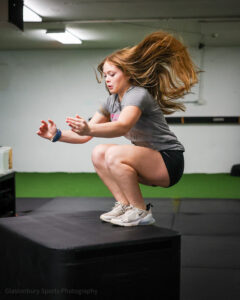 int means you are moving multiple joints and a time, to work multiple muscles at a time. It is extremely rare in sports that you will only ever move one joint at a time to accomplish something.
3-dimensional means you are going to move in multiple different planes of motion in a workout. Golf is primarily a rotational sport, and golfers are typically only rotating in one direction. A 3-dimensional approach to training insures that athletes have the ability to move, and produce force in the frontal (side to side), and saggital plane, (forward and back), and the transverse plane (rotational) so that they are competent in a variety of athletic and worldly situations.
At Elias Sports Performance, our evidence-based approach to training is built on general physicals preparedness to keep youth athletes strong and healthy all year round.